
Women's empowerment

LESSON

Lesson Learned: Strengthening the Leadership of Women in Local Democracy – Gram Panchayats (Village Councils in India)

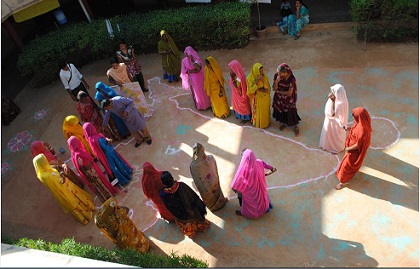
The training methods used by the grantee were appreciated by the participants. Trainees enjoyed gathering for several days in residential workshops, away from their home. They described with enthusiasm how the training generated environments that were free of discriminatory patterns and full of opportunities for learning, sharing and exchange.
UNDEF/ India
Project Partner
The Hunger Project - India
Project Description
The project aimed to strengthen the leadership of women elected into Gram Panchayats (Village Councils) in the state of Rajasthan. Project activities were undertaken pre- and post-elections. Pre-election the activities involved championing the women candidates. Post-election the project focused on helping women fulfill their roles and responsibilities as elected women representatives (EWRs). A pre-election campaign focused on the dissemination of simplified, complete and accurate information. The goal of this information was to counter various myths and misunderstandings that were used to discourage prospective women candidates. Campaign materials were well researched and created with great care, taking into account local needs and conditions. Following the elections, residential leadership workshops instilled confidence, self-respect, dignity and solidarity among the women representatives.
Evaluation Date
September 2011
Country
LESSON

Lesson Learned: Strengthening Women’s Leadership in Jamaica

The training included a practical exercise where by the 10 women were given small sums of money to implement a community project in their area of interest. This served to reinforce the learning and provided hands on experience to these women in a mentored environment. This helped ensure the success of most mini-projects which in turn helped increase the trainees’ confidence and self-esteem and contributed to their community’s perception of them as leaders.
Project Partner
Women's Resource and Outreach Centre
Project Description
The project aimed to address the under representation of women in decision making positions in Jamaica, particularly on the boards of private companies and public commissions. The project did this by: increasing the participation of women through training and awareness building and increasing the participation of women in leadership in community based organizations, including school boards, also through training and awareness building. It also sought to create a national conversation on the need to open spaces for women to participate in decision making. There was also a separate women’s leadership research activity undertaken in Trinidad and Tobago. Although women comprise more than 70% of university graduates in Jamaica, only 13% of parliamentarians are women and only 16% of the board positions in the private sector are filled by women. The project believed that by training 100 women it could make a strategic infusion of talented and enthusiastic women into the boardrooms, and transform their gender dynamics. The project met its main objective of increasing the number of qualified women trained and available for service on public commissions and private sector boards. Some of these women were already high profile leaders and board members, but most were entry and mid-professional women with leadership potential that still remained to be tapped.
Evaluation Date
September 2011
Country
LESSON

Lesson Learned: Empowering Civil Society and Women to Engage in Policy Processes

The project led to greater representation of women in decision making processes in the geographic areas covered by the project. The Women's Network in the municipalities contributed to enhancing participation and also played a role in setting a municipal policy agenda and carrying out social audits. The project also succeeded in mobilizing community based organizations and women's networks in extremely challenging socio-economic conditions of exclusion and extreme.
Project Partner
Oxfam Great Britain
Project Description
The project’s objective was to promote a new socio-political culture in Honduras that recognizes equal participation of women in democratic governance at the local, regional and national levels. The project prioritized women in rural living in extreme poverty. The target women had very few educational opportunities and had rarely participated in politics and in decision-making. The goal of the project was: to raise awareness among citizens on the importance of full and equal women's participation in decision-making processes and equal access to justice; to strengthen the capacity of Civil Society Organisations to influence policy processes; and to institutionalize a Women’s Network at the local level. The project explicitly aimed to integrate the gender approach across all three outcomes.
Evaluation Date
August 2011
Country
LESSON

Lesson Learned: Empowering Civil Society and Women to Engage in Policy Processes

One of the grantee’s implementation partners perpetrated significant fraud and had to be excluded from the project. Thanks to the solvency of the grantee, its organisation was able to find appropriate solutions to respond to these situations: using its own funds, it paid out an amount equivalent to the fraud in order to guarantee the implementation of the activities that had been initially planned. Financial and technical follow-up procedures were developed to ensure transparency in the management and to guarantee a good level of efficiency. Moreover, the grantee provided support and reinforcement of the capabilities of its implementation partners in financial and technical areas as well as in managing human resources.
Project Partner
Oxfam Great Britain
Project Description
The project’s objective was to promote a new socio-political culture in Honduras that recognizes equal participation of women in democratic governance at the local, regional and national levels. The project prioritized women in rural living in extreme poverty. The target women had very few educational opportunities and had rarely participated in politics and in decision-making. The goal of the project was: to raise awareness among citizens on the importance of full and equal women's participation in decision-making processes and equal access to justice; to strengthen the capacity of Civil Society Organisations to influence policy processes; and to institutionalize a Women’s Network at the local level. The project explicitly aimed to integrate the gender approach across all three outcomes.
Evaluation Date
August 2011
Country
LESSON

Lesson Learned: Empowering Civil Society and Women to Engage in Policy Processes

To promote the actual application of human rights in Honduras, a debate should be organised to improve links between the actions achieved for and with women -their community-based organisations and networks – and the actions intended to strengthen the institutional mechanisms that guarantee their rights. The aim would be to get local authorities to sustainably integrate a pro-woman agenda both in terms of political representation and municipal budgeting. Democratic participation is fragile and currently depends on the willingness of the authority in power. But this willingness could be replaced by a framework of legitimate and lasting good governance.
Project Partner
Oxfam Great Britain
Project Description
The project’s objective was to promote a new socio-political culture in Honduras that recognizes equal participation of women in democratic governance at the local, regional and national levels. The project prioritized women in rural living in extreme poverty. The target women had very few educational opportunities and had rarely participated in politics and in decision-making. The goal of the project was: to raise awareness among citizens on the importance of full and equal women's participation in decision-making processes and equal access to justice; to strengthen the capacity of Civil Society Organisations to influence policy processes; and to institutionalize a Women’s Network at the local level. The project explicitly aimed to integrate the gender approach across all three outcomes.
Evaluation Date
August 2011
Country
LESSON

Lesson Learned: Empowering Civil Society and Women to Engage in Policy Processes

Despite the coup d’état in Honduras, the project built up and maintained ‘spaces for visibility on women's issues'. Thus the project strengthened women's knowledge of their rights and their capabilities to defend and exercise these rights. It also provided women with a privileged place to participate in politics. The project therefore greatly contributed to the empowerment of women in a socio-political context that was characterised by the weakening, instability and lack of legitimacy of the spaces for democratic participation.
Project Partner
Oxfam Great Britain
Project Description
The project’s objective was to promote a new socio-political culture in Honduras that recognizes equal participation of women in democratic governance at the local, regional and national levels. The project prioritized women in rural living in extreme poverty. The target women had very few educational opportunities and had rarely participated in politics and in decision-making. The goal of the project was: to raise awareness among citizens on the importance of full and equal women's participation in decision-making processes and equal access to justice; to strengthen the capacity of Civil Society Organisations to influence policy processes; and to institutionalize a Women’s Network at the local level. The project explicitly aimed to integrate the gender approach across all three outcomes.
Evaluation Date
August 2011
Country
LESSON

Lesson Learned: Empowering Civil Society and Women to Engage in Policy Processes

The project outcomes were too ambitious to be met completely, especially when considering the limitations that resulted from the changes in the political context in Honduras during the first year of the project's implementation (coup d’état, June 2009).
Project Partner
Oxfam Great Britain
Project Description
The project’s objective was to promote a new socio-political culture in Honduras that recognizes equal participation of women in democratic governance at the local, regional and national levels. The project prioritized women in rural living in extreme poverty. The target women had very few educational opportunities and had rarely participated in politics and in decision-making. The goal of the project was: to raise awareness among citizens on the importance of full and equal women's participation in decision-making processes and equal access to justice; to strengthen the capacity of Civil Society Organisations to influence policy processes; and to institutionalize a Women’s Network at the local level. The project explicitly aimed to integrate the gender approach across all three outcomes.
Evaluation Date
August 2011
Country
LESSON

Lesson Learned: Empowering Civil Society and Women to Engage in Policy Processes

The grantee was a large international NGO. Its decision to implement this project with local partners reflected a collective strategic approach, centred on inter-institutional alliances and synergies. The local implementing partners involved succeeded in harmonising their strategic criteria and complementarity in the thematic and geographic areas of intervention.
Project Partner
Oxfam Great Britain
Project Description
The project’s objective was to promote a new socio-political culture in Honduras that recognizes equal participation of women in democratic governance at the local, regional and national levels. The project prioritized women in rural living in extreme poverty. The target women had very few educational opportunities and had rarely participated in politics and in decision-making. The goal of the project was: to raise awareness among citizens on the importance of full and equal women's participation in decision-making processes and equal access to justice; to strengthen the capacity of Civil Society Organisations to influence policy processes; and to institutionalize a Women’s Network at the local level. The project explicitly aimed to integrate the gender approach across all three outcomes.
Evaluation Date
August 2011
Country
LESSON

Lesson Learned: Empowering Civil Society and Women to Engage in Policy Processes

Project follow-up should have included applied research. The goal of such research would be to analyse critically and comparatively the various experiences and advances encountered by the project. This exercise should identify, in the context of a fragile democracy, the modalities and the possible alternatives for optimising women’s empowerment and guaranteeing as much as possible the application of the legal framework, as well as following up and carrying out the recommended support or judicial measures.
Project Partner
Oxfam Great Britain
Project Description
The project’s objective was to promote a new socio-political culture in Honduras that recognizes equal participation of women in democratic governance at the local, regional and national levels. The project prioritized women in rural living in extreme poverty. The target women had very few educational opportunities and had rarely participated in politics and in decision-making. The goal of the project was: to raise awareness among citizens on the importance of full and equal women's participation in decision-making processes and equal access to justice; to strengthen the capacity of Civil Society Organisations to influence policy processes; and to institutionalize a Women’s Network at the local level. The project explicitly aimed to integrate the gender approach across all three outcomes.
Evaluation Date
August 2011
Country
LESSON

Lesson Learned: The Bottom-up Governance and Leadership Programme for Women in the Pacific

The five funded mini-projects allowed selected women trainees use their newly acquired governance and leadership knowledge in their own communities. However the women were not given sufficiently useful tools to help them to do this since the BGLP training materials were in English and quite academic.
Project Partner
Foundation for Development Cooperation
Project Description
The project aimed to increase women’s political representation and increase their familiarity with governance issues and build their leadership skills. The project undertook training through an e-platform across four countries in the Pacific to achieve these goals. A subsequent “BGLP governance and leadership contest‟ was intended to promote bottom-up governance initiatives by women in their local communities. Those women who presented successful proposals went were given training in participatory project management training (PPM) and taken on a study tour before receiving funding to undertake their mini-projects. There was a mismatch in the project between the problem identified and the solutions proposed. Differences among the participating countries were not taken into account, and the method of training delivery was inappropriate.
Evaluation Date
April 2011
Country