Lessons

LESSON

Lesson Learned: Women Can Do It – Balanced Participation in Decision-Making

The project encouraged many women in Moldova to stand for selection as party candidates at local and district levels, while also enabling them to mount effective campaigns. It established a national cadre of well-qualified and highly committed trainers and women capable of being effective decision-makers. It showed large numbers of women how to network and collaborate with their peers across party lines and demonstrated the benefits of such collaboration.

Project Partner
Political Club of Women 50/50
Project Description
The purpose of the project was to empower women and encourage them to participate as candidates in the local elections in Moldova in 2011. The project’s methodology, as well as the philosophy and psychology of learning guiding it, derived from a training programme begun by the women’s organization of the Norwegian Labour Party developed in the early 1990s. The grantee utilized the core methodology in earlier, smaller-scale projects since 2001-2002. The emphasis throughout the project process was on building self-confidence and providing guidance on how to overcome the barriers to women realizing their potential as actors in the political process. The approach adopted proved highly pertinent to those involved, not only in relation to public life, but also in enabling them to rethink their place in the workplace, in the family, and in everyday life.
Evaluation Date
September 2011
LESSON

Lesson Learned: Strengthening the Leadership of Women in Local Democracy – Gram Panchayats (Village Councils in India)

In order to assess the progress of the elected women beyond the project the grantee should strengthen its data collection. This will also help maintain their strategic focus. Remaining - and new - needs among the elected women should be assessed before embarking on new training activity supporting the women’s federations.
Project Partner
The Hunger Project - India
Project Description
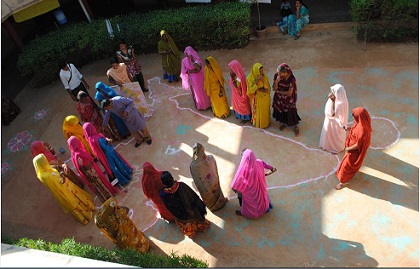
The project aimed to strengthen the leadership of women elected into Gram Panchayats (Village Councils) in the state of Rajasthan. Project activities were undertaken pre- and post-elections. Pre-election the activities involved championing the women candidates. Post-election the project focused on helping women fulfill their roles and responsibilities as elected women representatives (EWRs). A pre-election campaign focused on the dissemination of simplified, complete and accurate information. The goal of this information was to counter various myths and misunderstandings that were used to discourage prospective women candidates. Campaign materials were well researched and created with great care, taking into account local needs and conditions. Following the elections, residential leadership workshops instilled confidence, self-respect, dignity and solidarity among the women representatives.
Evaluation Date
September 2011
Country
LESSON

Lesson Learned: Empowering Civil Society and Women to Engage in Policy Processes

Despite the coup d’état in Honduras, the project built up and maintained ‘spaces for visibility on women's issues'. Thus the project strengthened women's knowledge of their rights and their capabilities to defend and exercise these rights. It also provided women with a privileged place to participate in politics. The project therefore greatly contributed to the empowerment of women in a socio-political context that was characterised by the weakening, instability and lack of legitimacy of the spaces for democratic participation.
Project Partner
Oxfam Great Britain
Project Description
The project’s objective was to promote a new socio-political culture in Honduras that recognizes equal participation of women in democratic governance at the local, regional and national levels. The project prioritized women in rural living in extreme poverty. The target women had very few educational opportunities and had rarely participated in politics and in decision-making. The goal of the project was: to raise awareness among citizens on the importance of full and equal women's participation in decision-making processes and equal access to justice; to strengthen the capacity of Civil Society Organisations to influence policy processes; and to institutionalize a Women’s Network at the local level. The project explicitly aimed to integrate the gender approach across all three outcomes.
Evaluation Date
August 2011
Country
LESSON

Lesson Learned: Empowering Civil Society and Women to Engage in Policy Processes

The project outcomes were too ambitious to be met completely, especially when considering the limitations that resulted from the changes in the political context in Honduras during the first year of the project's implementation (coup d’état, June 2009).
Project Partner
Oxfam Great Britain
Project Description
The project’s objective was to promote a new socio-political culture in Honduras that recognizes equal participation of women in democratic governance at the local, regional and national levels. The project prioritized women in rural living in extreme poverty. The target women had very few educational opportunities and had rarely participated in politics and in decision-making. The goal of the project was: to raise awareness among citizens on the importance of full and equal women's participation in decision-making processes and equal access to justice; to strengthen the capacity of Civil Society Organisations to influence policy processes; and to institutionalize a Women’s Network at the local level. The project explicitly aimed to integrate the gender approach across all three outcomes.
Evaluation Date
August 2011
Country
LESSON

Lesson Learned: Strengthening Civil Society Across Borders to Develop Democracy

The sustainability of the local NGOs was not assured. It is recommended that the local NGOs which participated in the project develop long-term relationships with local authorities; for example, permanent consultative status in an issue area or a multi-year arrangement to provide services. This will enhance financial sustainability in the most convincing way and help to avoid the trap of being dependent on recurrent one-time projects.
Project Partner
Euclid Network
Project Description
The project’s goal was to increase the capacity of NGOs in Moldova and Ukraine to network among themselves to enhance their advocacy skills and to improve the functioning of existing mechanisms for engagement between civil society and governments. The project resulted in a range of concrete initiatives, both at the local level and at the level of improved NGO representation in national policy making. Concrete impacts ranged from promoting the participation of blind voters to making amendments to the new law on associations in Ukraine and the human rights action plan in Moldova.
Evaluation Date
August 2011
Country
LESSON

Lesson Learned: Empowering Civil Society and Women to Engage in Policy Processes

The grantee was a large international NGO. Its decision to implement this project with local partners reflected a collective strategic approach, centred on inter-institutional alliances and synergies. The local implementing partners involved succeeded in harmonising their strategic criteria and complementarity in the thematic and geographic areas of intervention.
Project Partner
Oxfam Great Britain
Project Description
The project’s objective was to promote a new socio-political culture in Honduras that recognizes equal participation of women in democratic governance at the local, regional and national levels. The project prioritized women in rural living in extreme poverty. The target women had very few educational opportunities and had rarely participated in politics and in decision-making. The goal of the project was: to raise awareness among citizens on the importance of full and equal women's participation in decision-making processes and equal access to justice; to strengthen the capacity of Civil Society Organisations to influence policy processes; and to institutionalize a Women’s Network at the local level. The project explicitly aimed to integrate the gender approach across all three outcomes.
Evaluation Date
August 2011
Country
LESSON

Lesson Learned: Strengthening Civil Society Across Borders to Develop Democracy

The project was built on the premise that when civil society and government engage constructively and pro-actively, common ground will be found and better approaches and solutions developed. Results of the project confirmed that approach.
The watchdog role of NGOs is important and should complement rather than contradict an approach based on constructive engagement. The enhanced involvement of civil society in national policymaking in both Ukraine and Moldova was in part a result of the contribution of this project.
Project Partner
Euclid Network
Project Description
The project’s goal was to increase the capacity of NGOs in Moldova and Ukraine to network among themselves to enhance their advocacy skills and to improve the functioning of existing mechanisms for engagement between civil society and governments. The project resulted in a range of concrete initiatives, both at the local level and at the level of improved NGO representation in national policy making. Concrete impacts ranged from promoting the participation of blind voters to making amendments to the new law on associations in Ukraine and the human rights action plan in Moldova.
Evaluation Date
August 2011
Country
LESSON

Lesson Learned: Empowering Civil Society and Women to Engage in Policy Processes

Project follow-up should have included applied research. The goal of such research would be to analyse critically and comparatively the various experiences and advances encountered by the project. This exercise should identify, in the context of a fragile democracy, the modalities and the possible alternatives for optimising women’s empowerment and guaranteeing as much as possible the application of the legal framework, as well as following up and carrying out the recommended support or judicial measures.
Project Partner
Oxfam Great Britain
Project Description
The project’s objective was to promote a new socio-political culture in Honduras that recognizes equal participation of women in democratic governance at the local, regional and national levels. The project prioritized women in rural living in extreme poverty. The target women had very few educational opportunities and had rarely participated in politics and in decision-making. The goal of the project was: to raise awareness among citizens on the importance of full and equal women's participation in decision-making processes and equal access to justice; to strengthen the capacity of Civil Society Organisations to influence policy processes; and to institutionalize a Women’s Network at the local level. The project explicitly aimed to integrate the gender approach across all three outcomes.
Evaluation Date
August 2011
Country
LESSON

Lesson Learned: Strengthening Civil Society Across Borders to Develop Democracy

The extent to which cross-border ties between Ukraine and Moldova were maintained could have been enhanced by a better sustainability strategy to build the knowledge and experience sharing that took place as part of the project. The sustainability relies on the website. However the website of the project could have been better designed to become a forum for keeping in touch and fostering twinning arrangements.
Project Partner
Euclid Network
Project Description
The project’s goal was to increase the capacity of NGOs in Moldova and Ukraine to network among themselves to enhance their advocacy skills and to improve the functioning of existing mechanisms for engagement between civil society and governments. The project resulted in a range of concrete initiatives, both at the local level and at the level of improved NGO representation in national policy making. Concrete impacts ranged from promoting the participation of blind voters to making amendments to the new law on associations in Ukraine and the human rights action plan in Moldova.
Evaluation Date
August 2011
Country
LESSON

Lesson Learned: Empowering Civil Society and Women to Engage in Policy Processes

The project led to greater representation of women in decision making processes in the geographic areas covered by the project. The Women's Network in the municipalities contributed to enhancing participation and also played a role in setting a municipal policy agenda and carrying out social audits. The project also succeeded in mobilizing community based organizations and women's networks in extremely challenging socio-economic conditions of exclusion and extreme.
Project Partner
Oxfam Great Britain
Project Description
The project’s objective was to promote a new socio-political culture in Honduras that recognizes equal participation of women in democratic governance at the local, regional and national levels. The project prioritized women in rural living in extreme poverty. The target women had very few educational opportunities and had rarely participated in politics and in decision-making. The goal of the project was: to raise awareness among citizens on the importance of full and equal women's participation in decision-making processes and equal access to justice; to strengthen the capacity of Civil Society Organisations to influence policy processes; and to institutionalize a Women’s Network at the local level. The project explicitly aimed to integrate the gender approach across all three outcomes.
Evaluation Date
August 2011
Country