
journalism

LESSON

Lesson Learned: Grassroots Gender Accountability in Uganda

Investigative journalism was intended to critically review shortcomings discovered by VBCs throughout the project’s target districts; TV and radio shows were meant to overcome the lack of interfaces between the local population and duty bearers and to serve as a strategy for increased accountability. Furthermore, NGOs are still inviting the grantee’s Kibaale field officer to radio shows to share the approach and achievements of the monitoring work with a wider audience. One particular radio station has even offered free airtime. There is hence relevant impact towards transparent, gender-responsive local service provision in the form of vivid online readership discussion and comments in relation to the project’s investigative journalism outputs.
Project Partner
Forum for Women in Democracy
Project Description
The project worked to help women district councillors acquire knowledge and to push the equality agenda with policy makers. The project’s advocacy activities led to improved gender-sensitive service delivery, as the local government budgeted for enhanced services for women and girls. In September 2016, two years after the end of the project, the Government announced that gender sensitive indicators will be used to ensure that all sectors adhere to gender equality in decision making and service delivery in the country.. Visibly empowered district and sub-county councillors expressed with pride their new influence on the gender-sensitive application of laws, policies and local budgets. Former women MP trainees proudly cooperated across party lines on priority issues of the Ugandan women in parliamentary committees. The approach of putting in place a monitoring system that was run by Village Budget Clubs (VBCs) and district councillors alike was appropriate. The project’s training methodology ensured the transfer of necessary skills such as gender-sensitive analysis, budgeting, caucusing, lobbying and advocacy.
Evaluation Date
April 2014
Country
LESSON

Lesson Learned: Citizen Journalists for Free and Fair Elections in Georgia

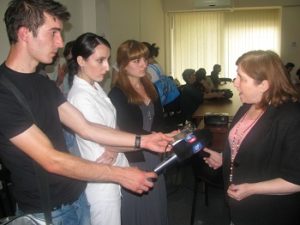
The project inputs were consistent with the delivery of the activities but not with the intent of developing citizen journalism. Embedding citizen journalism would have required more than a one-time training and payment for verified reports. In this regard, the project in Georgia lacked clarity of purpose and should have conceptualized a fully comprehensive development programme.

Project Partner
Civic Development Institute
Project Description
The project’s objective was to promote free and fair elections in Georgia. The project aimed to reduce electoral fraud and increase trust in the election results by involving citizens in monitoring and reporting on elections in cooperation with professional journalists. The citizen journalists, who included media professionals, NGO members and political party representatives, received training and some technical resources, including a memory stick and the grantee’s contact information. They were then left alone to report to the grantee about problems they have witnessed. The intervention was directly relevant to the need to strengthen the integrity of the electoral process and ensure the dissemination of objective information. Georgia lacked a tradition of citizen engagement or peaceful transfer of power through the ballot box. A financial incentive was used by the grantee, paying USD 40 for each verified report.
Evaluation Date
April 2014
Theme
Country
LESSON

Lesson Learned: Strengthening Somali Media Capacity for Democracy and Human Rights

The failure to adequately engage editors and publishers/owners undermined the project’s objectives, because the value of work on human rights, good governance and freedom of expression was not specifically conveyed to this important set of stakeholders (eg, many journalists fail to publish stories on human rights and good governance because editors and owners refuse them.
Project Partner
National Union of Somali Journalists
Project Description
The project aimed strengthened the capacity of the Somali media to implement principles and practices of democracy and respect for human rights by providing professional training to Somali journalists across the country, focusing on ethics and good journalistic practices, and holding workshops on good governance and human rights. The use of training sessions and workshops was appropriate to address the issue of journalists’ skills development. Creation of a media centre was also useful in helping journalists to do their work. However, the project's planned activities were not sufficient to address all its objectives. The number of participating journalists was on target, as was the ratio of women participants (30%). This is a very significant achievement, considering the prevalence of armed violence and high levels of political instability in many parts of Somalia during the project period. Significantly, the project benefited about half of Somalia’s journalists. On the other hand, the failure to address other stakeholders - government, editors, and publishers - reduced the likelihood of positive changes. However, the very fact that the project took place has to be seen as an achievement in its own right.
Evaluation Date
October 2011
Theme
Country
LESSON

Lesson Learned: Strengthening Somali Media Capacity for Democracy and Human Rights

The promotion of the role of the media and freedom of expression should have been the object of advocacy activities beyond the workshops. The grantee did conduct some advocacy activities, but these were not part of the UNDEF-funded project and addressed mainly the international community. Any follow-up project should include an advocacy dimension directed at government and local authorities, and should consider ways in which training sessions can be followed-up to further support participating journalists, for example through the use of social networks.
Project Partner
National Union of Somali Journalists
Project Description
The project aimed strengthened the capacity of the Somali media to implement principles and practices of democracy and respect for human rights by providing professional training to Somali journalists across the country, focusing on ethics and good journalistic practices, and holding workshops on good governance and human rights. The use of training sessions and workshops was appropriate to address the issue of journalists’ skills development. Creation of a media centre was also useful in helping journalists to do their work. However, the project's planned activities were not sufficient to address all its objectives. The number of participating journalists was on target, as was the ratio of women participants (30%). This is a very significant achievement, considering the prevalence of armed violence and high levels of political instability in many parts of Somalia during the project period. Significantly, the project benefited about half of Somalia’s journalists. On the other hand, the failure to address other stakeholders - government, editors, and publishers - reduced the likelihood of positive changes. However, the very fact that the project took place has to be seen as an achievement in its own right.
Evaluation Date
October 2011
Theme
Country
LESSON

Lesson Learned: Strengthening Somali Media Capacity for Democracy and Human Rights

Many junior journalists often lack basic training in journalism - and not only awareness of rights, good governance. The grantee could have included more practical exercises in the training curriculum. Other forms of training, such as mentoring of junior journalists by more senior one, should also be considered.

Project Partner
National Union of Somali Journalists
Project Description
The project aimed strengthened the capacity of the Somali media to implement principles and practices of democracy and respect for human rights by providing professional training to Somali journalists across the country, focusing on ethics and good journalistic practices, and holding workshops on good governance and human rights. The use of training sessions and workshops was appropriate to address the issue of journalists’ skills development. Creation of a media centre was also useful in helping journalists to do their work. However, the project's planned activities were not sufficient to address all its objectives. The number of participating journalists was on target, as was the ratio of women participants (30%). This is a very significant achievement, considering the prevalence of armed violence and high levels of political instability in many parts of Somalia during the project period. Significantly, the project benefited about half of Somalia’s journalists. On the other hand, the failure to address other stakeholders - government, editors, and publishers - reduced the likelihood of positive changes. However, the very fact that the project took place has to be seen as an achievement in its own right.
Evaluation Date
October 2011
Theme
Country
LESSON

Lesson Learned: Media, Transparency and Accountability in Albania

The project built on portions of an earlier media development project funded by USAID in Albania. As a result, most of the project framework was already in place, making implementation of the UNDEF-funded activities relatively straightforward. Most of the stations in its networks, and about half of its reporters, had already been trained under the previous USAID. project and the grantee was able to leverage this experience to its advantage. This helped to consolidate the position of investigatory journalism and the role of the media as a public watchdog. It also ensured that the Union functioned long enough to become an established part of the Albanian media environment.
Project Partner
IREX Europe/Hapur
Project Description
Media, Transparency and Accountability in Albania sought to strengthen the role of the Albanian media to promote transparency and government accountability by 1) investigating and informing citizens on issues of civic concern and corruption, and 2) developing, implementing and enforcing its own ethical and professional standards. The project did help to improve the media’s capacity to investigate and inform citizens on issues of corruption and civic concern, but that the difficulty in airing the shows on national TV, and in particular, national public TV, limited its potential impact, as did the lack of synergies with other anti-corruption or good governance activities. The mix of local and national topics for its reports seemed appropriate as it attracted the interest of both audiences and drew national attention to some of the problems in the local areas.
Evaluation Date
September 2010
Theme
Country