sustainability

LESSON

Lesson Learned: Empowering Communities Threatened with Displacement in Thailand

According to the grantee, a three-pronged approach, or a “triangle-to-move-the-mountain approach” literally translated from Thai, is necessary to bring about an enabling environment and long-lasting change:
a. Strengthening of networks and partners through capacity building, collaborative works, knowledge sharing;
b. Improvement of data, academic works, and communications related to the critical issues at hand;
c. Long-term investment in policy advocacy at district, provincial and national levels.
Project Partner
Chumchonthai Foundation
Project Description
Economic growth has benefited many citizens but has in some cases resulted in being a threat to cultural existence, livelihoods, and land/citizenship rights of communities. This project aims to promote the social, political and economic inclusion of marginalized communities in the Andaman region of Thailand, through capacity development, advocacy and community campaigning to eliminate discriminatory laws, policies, and practices. It seeks to help members of marginalized communities to gain legal identities and acquire the political and legal know-how, and organizational skills needed to assert their rights and in participating in decision-making processes. Moreover, it will support media and public-advocacy campaigns designed to increase local authorities’ knowledge of and compliance with laws and policies, recognizing the rights of marginalized people and communities.
Evaluation Date
December 2020
Country
LESSON

Lesson Learned: Bytes Without Borders in Morocco

The capacity-building process is a marathon, not a sprint. It must involve regular coaching of trainees and performance monitoring in order to ensure sustainability. In order for capacity-building activities to achieve their intended results, one must ensure the activities are inclusive to all, including the vulnerable and illiterate. The use of audio-visual approaches in social media has proved to reach a larger number of people than the 'class-format' approach.

Project Partner
Association Marocaine des Droits Humains
Project Description
The proposed project aims to promote online citizen journalism and improve access to information on the freedom of expression as a cornerstone for good-governance in Morocco. This project will be supported by a national multi-stakeholder platform and will validate a legislative proposal for the defense of the digital space in Morocco. The project will strengthen Moroccan CSOs' skills and aid journalists, lawyers and social movements on gender issues pertinent to digital rights with the support of 45 awareness campaigns on the freedom of speech and the right to information.
Evaluation Date
September 2018
Theme
Country
LESSON

Lesson Learned: Fostering Ethical Democracy and Advancing Micro Justice in India


This project provides a good model of planning for project sustainability. The grantee planned for sustainability in every component of the project, leaving nothing to change. This particular grantee's experience suggests that projects that deliver tangible benefits to communities may be sustained by those communities themselves.


Project Partner
DHAN Foundation
Project Description
This project aims to improve the provision of local democratic services to women, youth and students in disadvantaged communities in 5 regions. It will facilitate capacity development and create an enabling environment for Women Self Help Groups, youth associations and student groups to support their own "democracy action" initiatives. The project also seeks to initiate intensive campaigns on the Right to Information Act, in developing informed citizens. Additionally, the project will develop micro justice initiatives to address problems of infringement of rights; establishing para-legal clinics to facilitate the insurance of citizen rights and entitlements for development.
Evaluation Date
September 2018
Theme
Country
LESSON

Lesson Learned: Strengthening Human Rights Protection Through Legal Education in Haiti

UNDEF has a unique approach within UN agencies and its support for civil society remains essential. Despite the small size of the structure and the limited number of staff,  UNDEF provides assistance to organizations to help them through a rigorous process. Even though the success of the project was limited, UNDEF has helped ensure that this necessary and indispensable organization can be maintained.
Project Partner
Platforme des organisations haitennes des droits humains
Project Description
The project aimed to build the capacity and skills of community actors such as farmers' organizations, youth organizations and women's organizations to defend and uphold their rights. The grantee aimed to capitalize on the experience and realities of these groups and to stimulate their effective and responsible participation in the mobilization for the respect of fundamental human rights in the country. It also wanted the project to address the low level of knowledge of community actors, vulnerable groups and local authorities on human rights as well as State authorities' obligations in respect of human rights. Legal education on the chain of protection of human rights in Haiti, the mobilization of local actors on this thematic and the establishment of legal clinics were the main elements of the project implementation strategy. The evaluation focused on assessing the results of the activities trying to identify changes that could be reasonably attributed to them. While the overall aims of the project were relevant, the project largely failed to achieve the intended results. The negative consequence in not doing enough monitoring was that activities and impacts cannot be measured. The project was neither effective nor efficient as facilitators/animators were unable to create or reinforce networks of human rights observers in the targeted communities and human rights violations failed to be systematically documented. Observation reports were based on too few and poorly documented cases and legal aid was not provided as intended. The few trainings and meetings that brought together locally elected authorities, justice system representatives and members of grassroots organizations did facilitate exchanges that are still ongoing after the projects’ closure and continue to contribute to legal education and social dialogue.
Evaluation Date
June 2018
Theme
Country
LESSON

Lesson Learned: Advancing Pedestrian Rights in Georgia

A CSO’s search for sustainability is never-ending. Every new project should include the “seeds” - innovative strategies -  of future sustainability. Additionally, since securing funds from a specific international donor can take months or years, CSOs should continue fundraising and cultivating donors even in relatively “flush” times.
Project Partner
Iare Pekhit
Project Description
 The project was generated by UNDEF itself, which approached the grantee and asked it to design the initiative as a response to the asymmetrical power balance between cars and humans in many post-Soviet cities. The project objective was “To create a systematic long-term approach and corresponding tools to effectively impact pedestrian strategy development and state accountability to pedestrian policy development and execution.” The project focus was timely and relevant. The project approach was innovative and agile in adapting to shifts in the context. The project achieved its objectives and was cost-efficient and well managed. Although it faces sustainability challenges, the project approach and grantee could potentially adapt and tailor their work to both international donors and other interested stakeholders. UNDEF’s flexible approach; initiative in generating project ideas; and willingness to generate a project in partnership with a small organization in response to a particular need are valuable assets in the context of this project.
Evaluation Date
January 2018
Country
LESSON

Lesson Learned: Strengthening Democratic Participation and Inclusive Local Development in Indigenous and Peasant Communities in Bolivia

Sustainability is the Achilles’ heel of democracy projects. To ensure the continuation of services beyond the end of project funding, projects need to plan for sustainability from the start, as design and implementation will require: creative partnerships with civil society and State organizations; careful analysis of the level of demand and willingness to pay; the creation of a cadre of competent professionals able to provide continuous service; and empowerment of community members to provide orientation or counsel, as feasible.
Project Partner
Microjusticia Bolivia
Project Description
The project was implemented between 2014 and 2016 by the Fundación MicroJusticia Bolivia (MJB), a branch of Microjustice4All (MJ). The project objective was to legally and politically empower members and leaders of indigenous communities, women and men, in La Paz and Oruro to protect and exercise their civil and indigenous rights and participate in democratic decision-making processes. The project objectives included: an increase in the number of people holding basic legal documents; increased awareness in the target groups of the importance of having their basic legal documents (identity, legal, personality) in order; strengthened capacity of members, leaders and organizations of traditionally excluded indigenous communities to participate in democratic processes and to exercise their civil and indigenous rights; and improved access to basic legal documents through evidence-based inputs for institutional reforms through advocacy. The project was timely and relevant to participant needs and the political and cultural context in Bolivia. The potential impact could be extended beyond legal and political rights to also enhance socio-economic development once legalized communities are able to access government projects and resources. The project was cost-efficient and well managed. The project’s focus on community ownership contributed to sustainability of results, though Microjusticia’s own sustainability and ability to operate is dependent on additional external funding.
Evaluation Date
August 2017
Theme
Country
LESSON

Lesson Learned: Strengthening Participation of Women in Geographically Deprived Communities in Local Governance in Ghana

The challenge of how to sustain the Women’s Group Advocacy Platforms was not well addressed in the project design and implementation. The grantee’s project document anticipated that the operational cost of sustaining a women’s advocacy group would reach $10,000 US per year; however no activities were conducted to raise these funds nor were any staff members given responsibility for the development and implementation of the sustainability activities.
Project Partner
Gender Centre for Empowering Development
Project Description
The project’s objective was to increase participation of women in decision making to develop sustainable, decentralized, bottom-up planning processes in Ghana. The grantee institutionalized Women’s Group Advocacy (WOMGA) Platforms to engage and dialogue with local government authorities in decision making processes on public service delivery. At the heart of the project strategy was the mobilization and empowerment of 150 women, who were trained and deployed to monitor policy implementation at the district level using a Gender Monitoring and Tracking Tool, and to champion the participation of women in local planning and implementation processes. The project’s intervention logic was sound and had clarity and coherence. Institutionalizing the WOMGA Platforms facilitated regular engagement with local government authorities, and hence effectively contributed to the overall development goal of increasing women’s participation in decision-making process on public service delivery. Local officials commended the high level of preparation they had to undertake for the public sessions the project held, during which they faced thorough questioning by the WOMGA members and the community.
Evaluation Date
June 2017
Country
LESSON

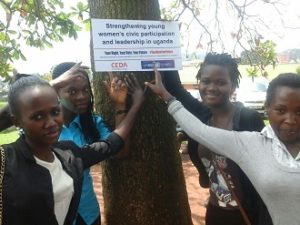
Lesson Learned: Strengthening Young Women’s Civic Participation and Leadership in Uganda

Six months after the end of the project in Uganda, beneficiaries were still expecting financial support and guidance from the grantee. Systematic and active involvement of the project beneficiaries during various follow-up activities could have enhanced their ownership and ensured their long term commitment to the project activities and results.
Project Partner
Century Entrepreneurship Development Agency
Project Description
The project’s objective was to strengthen the political leadership capacity of 1,500 young women from 10 public and private universities based in five districts of Uganda. The grantee aimed to increase awareness among the project’s target group and to provide them with access to information about women’s political life, as well as civic, voting, electoral and democratic processes. This was expected to enhance the leadership capacities of the young women to participate in the March 2016 general elections. Following these elections, an additional component was included in order to create a platform for leadership development of young women in Uganda. Although women’s political advancement at the time of project implementation was a national priority, the actual implementation of related international, regional and national legal and policy commitments remained an important challenge. This was due to persisting socio-cultural factors, such as the high illiteracy rate among youth and girls, lack of access to appropriate information related to political, human and civic rights, early marriage and sexual and gender based violence. While highly relevant in this respect, the project did not address the significant risk of SGBV that young women are exposed to because of their interest in political participation.
Evaluation Date
May 2017
Country
LESSON

Lesson Learned: Strengthening Young Women’s Civic Participation and Leadership in Uganda

The project successfully established mentoring clubs in 10 public and private universities located in five districts in Uganda all of which are still functioning six months after the end of the project. More than half of the project beneficiaries interviewed indicated that they were still active as mentors supporting other young women.

Project Partner
Century Entrepreneurship Development Agency
Project Description
The project’s objective was to strengthen the political leadership capacity of 1,500 young women from 10 public and private universities based in five districts of Uganda. The grantee aimed to increase awareness among the project’s target group and to provide them with access to information about women’s political life, as well as civic, voting, electoral and democratic processes. This was expected to enhance the leadership capacities of the young women to participate in the March 2016 general elections. Following these elections, an additional component was included in order to create a platform for leadership development of young women in Uganda. Although women’s political advancement at the time of project implementation was a national priority, the actual implementation of related international, regional and national legal and policy commitments remained an important challenge. This was due to persisting socio-cultural factors, such as the high illiteracy rate among youth and girls, lack of access to appropriate information related to political, human and civic rights, early marriage and sexual and gender based violence. While highly relevant in this respect, the project did not address the significant risk of SGBV that young women are exposed to because of their interest in political participation.
Evaluation Date
May 2017
Country
LESSON

Lesson Learned: Civic education and empowerment for more women in leadership, from villages to parliament in Fiji

The project was managed on a somewhat ad-hoc basis. The grantee was working with reduced human resources and there were weaknesses in the management capacity of the team. Lack of SMART key-indicators and, of a formal monitoring system was another problem. The grantee board members and project manager also had scarce and irregular contacts with the implementing organizations, a situation that jeopardizes achievement of expected outcomes and sustainability of the grantee’s goal of building a network.
Project Partner
National Council of Women Fiji
Project Description
The project aimed to increase women’s representation in public office as part of wider support for women’s representation in political processes and civic leadership in Fiji. The project strategy was structured around three expected outcomes: increased awareness and knowledge of civic education principles among potential women leaders in Fiji; increased capacity of potential women leaders for active participation in civil leadership within both parliament and administrative boards and councils in Fiji and increased awareness within the broader community of the importance of the involvement of women in political processes and civic leadership in Fiji. The project had some success, in particular in training marginal women who are usually excluded from mainstream education and in working with church groups and political parties from across the political spectrum. Implementation, however, was marred by a number of administrative and management shortcomings including a lack of SMART indicators and irregular communication. In addition, the project encountered a number of external challenges including political tensions that generated delays in implementation and the tropical cyclone in February 2016 that left homeless ten thousands of people.
Evaluation Date
July 2016
Country